


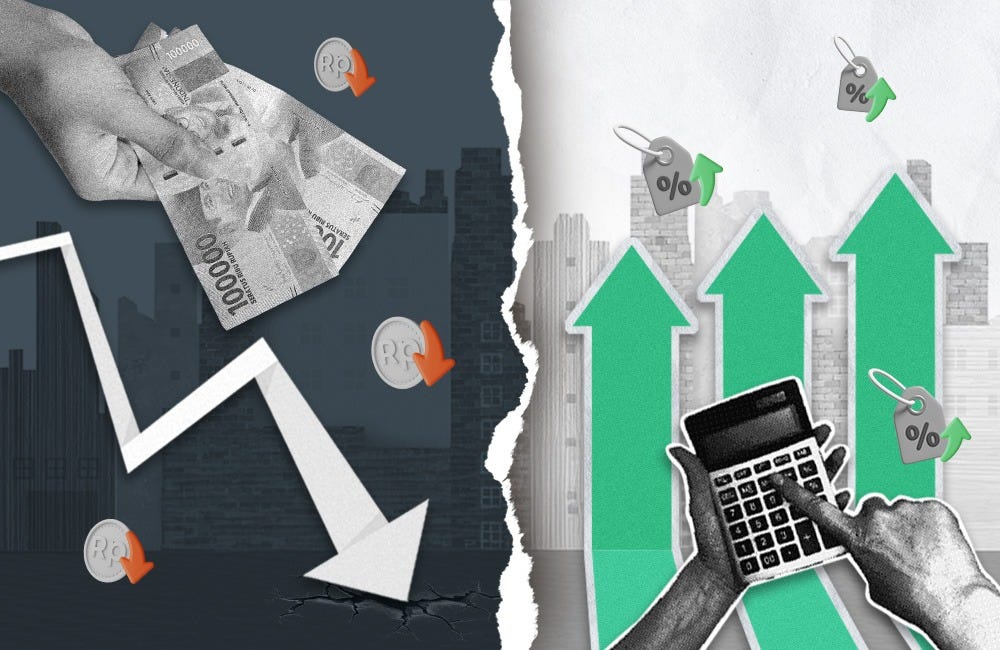
The Indonesian government has recently released several closely watched economic indicators, including the country’s 3Q25 GDP growth and inflation rate as of Oct-25.
We observe an interesting pattern where household consumption growth has decelerated, yet prices have continued to climb meaningfully, raising the question of whether Indonesia is experiencing stagflation risks.
Similar concerns were flagged in 2022–2023 when global policy divergence (i.e. Russia–Ukraine war) drove sharp increases in commodity prices such as oil, coal, and nickel.
At that time, however, global supply-side risks eased relatively quickly, while domestic demand remained resilient as household incomes were stable and the government effectively managed inflation.
Afterward, Indonesia faced deflationary pressure in 2024 because of rising job losses, the spread of online gambling, a pause in capital expenditure, falling exports, and political transition, leading to a steep decline in demand.
Nevertheless, despite expansionary policy efforts over the past year, softening demand has persisted in 2025 as income levels have not improved.
Now, the government is banking on a final-quarter fiscal push like social assistance and MSME credit disbursements to ensure that the +5.2% 2025 full year GDP growth target is achieved.
However, this appears overly optimistic, as it would require 4Q25 growth of +5.76% YoY, implying a massive boost not only to public spending but also to private consumption, investment, and exports.
Ultimately, the structural economic issues of weakening consumption and decreasing income, combined with increasing price levels, are likely to remain unless major policy reforms are implemented.