


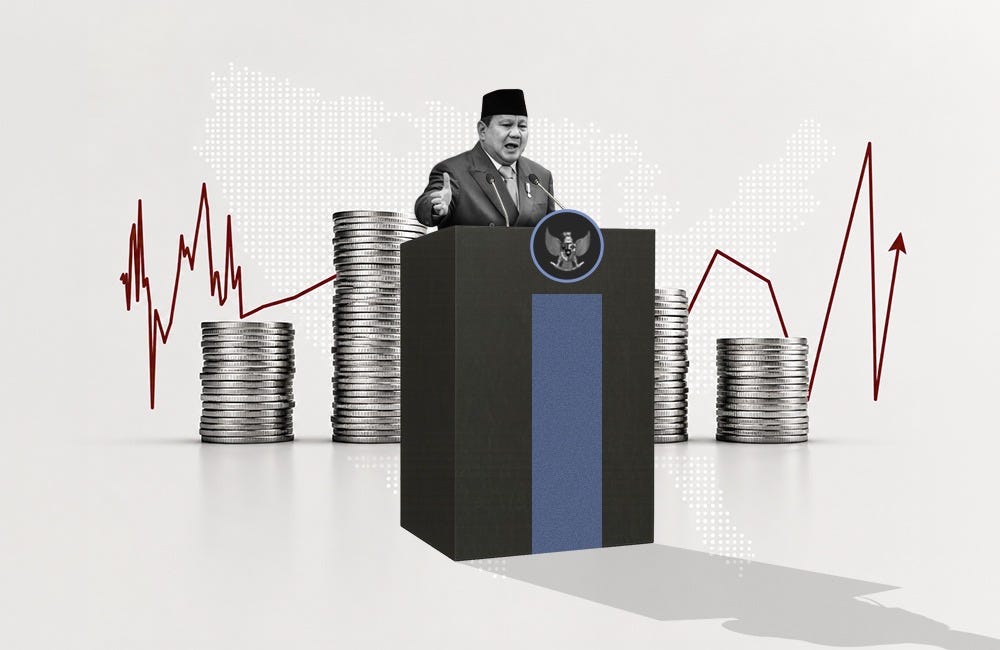
During the Plenary Session of the House of Representatives (DPR RI) in May 2026, Indonesian President Prabowo Subianto laid out the Macroeconomic Framework and Fiscal Policy Principles (KEM PPKF) for the 2027 State Budget (APBN).
2027 economic assumption
The Indonesian government targets state revenue at 11.82–12.40% of GDP, while state expenditure is expected at 13.62–14.80% of GDP. GDP growth is projected at 5.8–6.5% next year, with the government aiming to accelerate growth toward 8% by 2029. Based on these assumptions range:
Under a growth scenario of +5.8% YoY and low-end of the range, this implies IDR 3,140 trillion (-0.4% YoY) and IDR 3,618 trillion (-5.9% YoY) in government revenue and spending, respectively, with the budget deficit at -1.8% of GDP.
Under a growth scenario of +6.5% YoY and high-end of the range, it expects IDR 3,316 trillion (+5.1% YoY) and IDR 3,957 trillion (+2.9% YoY) in total revenue and spending, respectively, with the budget deficit at -2.4% of GDP.
In both cases, the government says fiscal discipline will be strictly maintained to support strategic programs while keeping financing prudent, with inflation expected to stay within 1.5–3.5% and the unemployment rate at 4.3%-4.87%.
Moreover, the 10-year government bond yield is estimated at 6.5–7.3%, while the USD/IDR exchange rate is assumed at 16,800–17,500.
For energy, the Indonesian Crude Price (ICP) is projected at $70–95/barrel, with oil lifting targeted at 602,000–615,000 bpd and gas lifting at 934,000–977,000 boepd.
As always, the President also highlighted the achievements of the most prioritized program, the Free Nutritious Meal (MBG), which has distributed 8.3 billion portions since its inception.
The program now serves 62.4 million meals daily, including 374,175 schools receiving benefits. Around 1.28 million workers have reportedly been employed as part of the program.
There are now 28,913 SPPG kitchens and 28,390 BGN (National Nutrition Agency) partners operating, involving 140,289 suppliers, including MSMEs, co-ops, and village enterprises.
The initiative has also injected around IDR 45 million per kitchen per day into village economies, translating to IDR 10.8 billion per kitchen annually, which is said to drive grassroots empowerment and localized job creation.